Sleep & Circadian Methods Research Core
The Sleep and Circadian Methods Research Core supports investigators in the appropriate use of sleep and circadian methods across child and adolescent development.
The Sleep and Circadian Methods Research Core (SCM) supports measurement selection, data acquisition, data analysis, and interpretation of sleep and circadian processes tailored to research questions and the needs of investigators. The SCM Research Core facilitates access to specialized laboratory, instrumentation, software, and database resources required for sleep and circadian science. The SCM Research Core also provides training in best practices to integrate sleep and circadian science into pediatric mental health research.
The SCM Research Assistants host in-person office hours at Bradley Hospital (1011 Veterans Memorial Parkway, Riverside RI) and the Coro Building (1 Hoppin Street, Providence RI). Appointments can be made ahead of time using the following links but are not required.
Click here to schedule an in-person consultation at Bradley (Mondays 12:00-15:00)
Click here to schedule an in-person consultation at Coro (Tuesdays 13:00-17:00)
| Research Task | Direct Support | Training | Consultation Services | Resource Library |
|---|---|---|---|---|
| Study Conceptualization | ||||
| Understanding sleep and circadian theory | ✔ | ✔ | ✔ | ✔ |
| Development of appropriate research questions | ✔ | ✔ | ✔ | |
| Selection of appropriate sleep and circadian measures relevant to the proposed research question | ✔ | ✔ | ✔ | |
| Study Design | ||||
| Designing research protocols | ✔ | ✔ | ✔ | |
| Human subjects’ protections for vulnerable populations | ✔ | ✔ | ✔ | ✔ |
| Selection of appropriate instrumentation & equipment | ✔ | ✔ | ✔ | ✔ |
| Data acquisition and storage | ||||
| Designing data acquisition protocols | ✔ | ✔ | ✔ | ✔ |
| Designing and implementing quality assurance protocols | ✔ | ✔ | ✔ | ✔ |
| Access to data organizational infrastructure | ✔ | ✔ | ✔ | ✔ |
Services
- Resource library that includes selected readings, standard language for grant and institutional review board applications, protocol examples, didactic documents, and scoring and analytic syntax.
- Assistance with acquisition, quality assurance, scoring of sleep and circadian measures and assistance with analysis and visual representation of sleep and circadian data. The support is calibrated to the needs of each project.
- Training in current best practices and for identifying novel methodological, measurement, and analytic approaches to sleep and circadian assessments suitable for pediatric mental health populations. We maintain a working group of researchers to discuss novel developments in the assessment of sleep and circadian processes.
The Sleep/Chronobiology Laboratory
The main Sleep Lab building include offices, a conference room, and two attic storage areas in addition to a full, 4-bedroom Sleep and Chronobiology Lab.
The second building, the “Annex,” has offices and a large conference/classroom equipped with audio-visual equipment including a bidirectional webinar interface, additional storage for biospecimens, and soon will be the home of the DNA / ELISA Laboratory.
The Sleep/Chronobiology Laboratory Bedrooms
The Sleep and Chronobiology Lab and each of the 4 bedrooms is comfortably appointed and equipped with:
- Digital data acquisition systems (Compumedics Grael systems) allow acquisition 40 physiological (or transduced) signals from each bedroom with simultaneous video recording
- Digital polysomnographic recorders
- Visual monitoring (with remote pan, zoom and tilt controls; video monitoring is functional in normal light, dim light, and infrared (IR) light available in each bedroom)
- Audio monitoring (intercom system, and participant’s vocalizations are picked up through ceiling mounted microphones)
- A small examination room with lockable refrigeration
- A -20ºC freezer for immediate storage of biological samples
- Two small centrifuges are used for handling saliva samples
- Epindorff refrigerated centrifuge
- Single beds with cranks to raise head, feet, or knees
- A small desk with personal computer for performance testing
- Tech-controlled ambient temperature and lighting with Hue bulbs
- Noise dampening interface between the floors
- A/V door annunciator links the technical staff to the Sleep Lab’s main entrance
 Sleep and Chronobiology Ambulatory Equipment
The Sleep and Chronobiology Lab also provides a variety of ambulatory monitoring equipment including:
- Two ambulatory Somte PSG V2 amplifier systems for home PSG
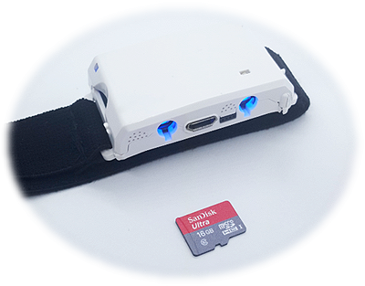
- Multiple types of actigraphy including the Actigpatch (Circadian Positioning Systems) and Micro Motionlogger actigraphs (Ambulatory Monitoring, Inc) that can monitor ambient light exposure and surface temperatures
- ZMax headbands (Hypnodyne, Inc). These small, wearable devices involve a research-grade disposable Ag/AgCl electrode strip and a miniature amplifier/recorder. The devices record data from two frontal EEG electrodes (F7 and F8) at 256 samples per second, allowing for data collection in naturalistic sleep settings.
- Equipment and protocols for collecting Dim light melatonin from saliva samples.
Processing of Sleep and Chronobiology Data
In addition to the Sleep and Chronobiology Laboratory, the Sleep and Circadian Methods Research Core provides services for processing, analyzing, interpreting, and storing your data. Services include:
- Facilities, instrumentation, software, and database resources, required for acquisition, storage, and scoring sleep and circadian data
- Coordination of access to lab and instrumentation (polysomnography, actigraphy, wearables, light monitors, etc.)
- Data storage for the intensive data sets
- Access and assistance to scoring protocols and software
- Entry of sleep and circadian data into the HIPAA compliant database maintained by PB Core.
- Utilization of open-source MATLAB-based ‘Hume’ toolkit for processing and storing human sleep EEG data. The toolkit facilitates the scoring and staging of human sleep, marking events of interests (e.g., arousals, sleep spindles), identifying signal artifacts, and calculating summary statistics relating to sleep architecture and timing.
- Utilization of Hume with custom routines for quantitative signal processing (e.g., power spectral analysis, phasic-event-detection) creating a dynamic toolbox for analyzing sleep EEG. The customized user-interface allows for utmost flexibility to process sleep physiological data according to each of our study demands. Finally, Hume interfaces with an enterprise level SQL database on our institution’s secure servers which organizes the storage of our labs’ sleep EEG statistics in a relational framework quickly able to facilitate novel cross-study investigations over our 3 decades of sleep research at Brown.
- Dedicated scoring and analytic computers maintained for use with Hume and multiple analytic software including SPSS, SAS, MATLAB, STATA, and R.
- The assurance of that your study data is safe via daily backup of server data by Lifespan CIS and 24- hour/7-day technical support for the servers, computers, and printers on the local area network.